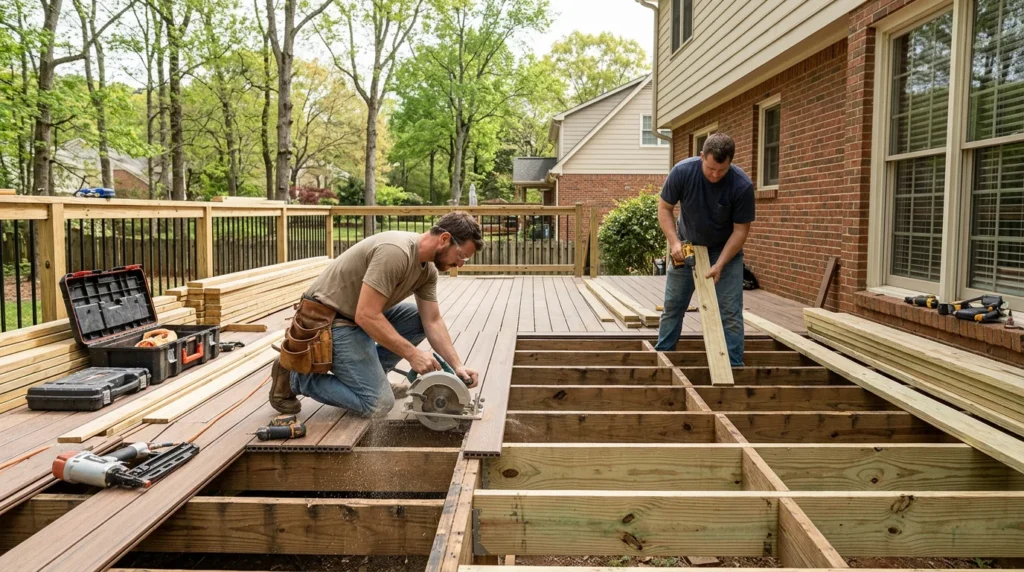
Quick answer: If the framing is solid and rot is limited to surface boards, a remodel usually makes sense: replace decking, railings, stairs, and hardware while keeping the structure. Full replacement is smarter if posts, beams, joists, or ledger connections show rot, insect damage, or unsafe movement. Check connections at the house, post bases, and how much the deck sways or bounces under normal walking.
Quick Signs Your Deck Is a Remodel Candidate
A deck remodel focuses on the parts you touch and see most: deck boards, railings, stairs, and sometimes the top few inches of framing. If the deck feels generally firm underfoot and the main structure looks dry and intact, remodeling can extend its life and improve safety and appearance without starting from scratch. In the Athens area, long humid stretches and sudden downpours can keep shaded decks damp for days, so pay extra attention to spots that stay wet: under planters, against the house, and anywhere leaves collect. Homeowners searching for deck remodeling Athens GA are often trying to solve exactly that mix of wear and moisture exposure without rebuilding a whole structure.
Look for issues that are annoying but not structural: splintering boards, popped fasteners, wobbly rail sections, and stair treads that flex slightly but don’t show deep rot. If you can replace surface materials, upgrade railings, and correct water traps, a remodel is often the practical reset.
A good remodel also fixes water management. Re-spacing or replacing decking, improving ventilation, and correcting areas where dirt stays packed and wet can prevent the same problems from returning quickly.
Safety First: When to Stop Using the Deck
Stop using the deck and schedule a structural inspection if you see any of these conditions: visible separation between the deck and the house at the ledger; a deck that noticeably sways side-to-side when an adult leans on the railing; posts that are soft, crumbling, or visibly rotted at the base; or connections where bolts/screws have pulled out or the wood around them is crushed.
Also treat it as urgent if the railing moves more than a little with a firm shake, stairs feel like they’re peeling away from the stringers, or you hear sharp cracking sounds during normal walking. These are not “cosmetic” problems, and continuing to use the deck can make failure more likely.
Red Flags That Point to Full Replacement
Replacement is usually the safer call when the skeleton is compromised. Rot at posts, beams, joists, or the ledger connection tends to spread because the same moisture path keeps feeding it. Probe suspect wood with a screwdriver: if the tip sinks in easily, the fibers crumble, or you can dig out punky material, that’s a strong sign the member has lost strength.
“Major sagging” is something you can see without measuring: a beam line that looks bowed, deck boards that form a shallow dip toward the middle, or stairs that feel like they’re tilting. “Major bounce” is more than normal springiness—think of a noticeable trampoline-like feel during regular walking, dishes or furniture visibly vibrating, or a railing shake that makes the whole platform move. Those are practical indicators that framing, spans, or connections may be undersized, deteriorated, or loosened.
The ledger board (where the deck attaches to the house) is a common failure point. Staining on the house rim area, missing flashing, rusted hardware, or fasteners that look randomly placed can indicate risk. If you see gaps opening at the ledger, water damage behind it, or the deck pulling away from the house, replacement or major structural rebuild is frequently needed.
A Practical Inspection Checklist: Remodel vs Replace
Use this checklist to sort what you’re seeing. These are rules of thumb, not a substitute for a structural evaluation, but they help you decide what to ask for.
1) Walk test: Walk normally across the deck and up/down stairs. If you feel mild flex only at a few boards, that often points to worn decking (remodel territory). If the whole platform feels bouncy, or the motion seems to come from the frame beneath you, suspect structural issues (leaning toward rebuild).
2) Railing and stair test: Give rail sections a firm shake and step on the outer edges of treads. If only the rail components are loose at their fasteners, rails can often be rebuilt during a remodel. If the posts themselves move at the base or the entire deck shifts, treat it as structural (replacement/structural repair).
3) Probe the usual rot zones: Use a screwdriver at (a) post bases near soil or concrete, (b) joist ends near the rim board, (c) beam-to-post connections, and (d) the ledger area. Surface splinters and shallow softness may be limited to decking (remodel). Deep softness, crumbling wood, or widespread dark staining at multiple structural members suggests replacement.
4) Look for water traps: Leaves packed between boards, soil piled against posts, and unflashed ledger areas often explain repeated rot. If the structure is still sound, correcting these during a remodel can make the upgrade last longer. If the structure is already deteriorated in those zones, rebuilding is usually the cleaner fix.
If you want a clear recommendation based on what’s reusable and what isn’t, Tipton’s Fine-Tuned Carpentry can help you evaluate the deck and map out next steps.