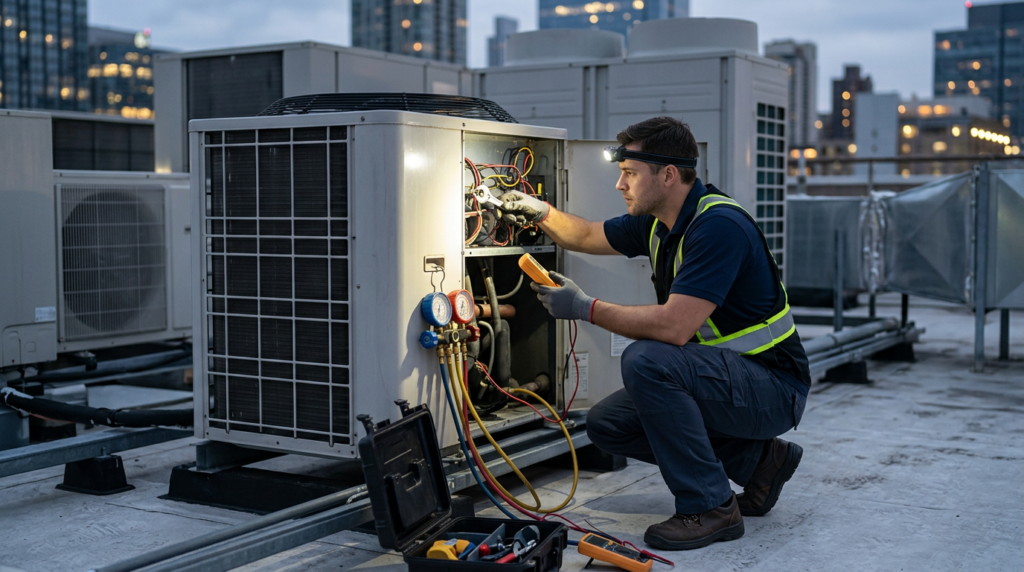
Quick answer: Call 24/7 emergency commercial HVAC service in DuPont when a failure is actively risking safety, inventory, equipment, or an inability to operate—like no heat in freezing weather, no cooling in a packed dining room, a temperature-controlled space drifting out of range, burning smells, tripped breakers tied to the unit, or water pouring from equipment. If the issue can’t wait until morning without real damage or shutdown, it’s an emergency.
What Counts as an HVAC Emergency for a Business
A true HVAC emergency is any breakdown that forces you to close, threatens product, or creates a safety hazard. That can mean a rooftop unit that won’t start during business hours, a ventilation failure that pushes smoke and heat into the space, or a temperature-controlled area drifting out of range. If you’re deciding between “annoying” and “dangerous/expensive,” focus on what could be damaged in the next few hours.
Common red flags that justify calling DuPont 24/7 emergency commercial HVAC service fall into three buckets. Safety: burning/electrical smell, visible sparking, smoke, suspected gas odor, or water reaching electrical components—these can escalate quickly into fire, shock, or indoor-air hazards. Equipment-damage: repeated breaker trips, loud grinding/metal-on-metal sounds, hard starts, or rapid short-cycling—these often point to electrical faults or failing motors/compressors that can turn a repair into a replacement if they keep running. Inventory-risk: spaces that must stay within a temperature range (food, meds, certain equipment rooms) drifting out of range—once product warms up or humidity spikes, the loss can be irreversible even if the unit is repaired later.
If you have multiple zones, a single failed unit might not be an emergency if you can isolate the area and keep customers and staff comfortable elsewhere. A whole-building outage, server room cooling failure, or anything impacting life-safety systems should be treated as urgent.
Call Now vs. Wait Until Morning
Use this quick decision guide to choose the right next step.
| Scenario | Call now or wait? | Immediate action |
|---|---|---|
| Burning smell, smoke, sparking, or a unit making an electrical “buzz” and then dying | Call now | Shut the unit off if a labeled disconnect is safely accessible; clear the area; call emergency services if smoke/fire is present |
| Breaker trips repeatedly when the HVAC tries to start | Call now | Stop resetting the breaker; leave the system off to prevent wiring/motor damage |
| Water pouring from equipment or leaking into ceilings near lights/outlets | Call now | Shut the unit down; protect electronics; place containment if safe; keep people away from wet electrical areas |
| No heat during freezing conditions (risk of frozen pipes) or no cooling during extreme heat with occupied space | Call now | Move occupants to safer areas; use temporary measures (fans/space heaters only if permitted and safe); monitor indoor temps |
| Temperature-controlled inventory space drifting out of acceptable range | Call now | Keep doors closed; move high-value product to a stable unit if available; document temps and times |
| One zone uncomfortable, but the rest of the building is operating normally | Often can wait | Isolate the area; adjust schedules; replace a known-dirty filter if you have spares; monitor for worsening symptoms |
| Minor airflow issue with no alarms, no unusual noise, and stable temps | Usually can wait | Check thermostat settings/schedule; confirm vents aren’t blocked; plan a service call for business hours |
If any “wait” situation shifts into safety concerns, repeated shutdowns, or temperatures moving quickly, treat it like a call-now event.
Quick Checks to Do Before You Call (and What Not to Touch)
You can save time by confirming a few basics. Check your thermostat or controller for a blank screen, low batteries (if applicable), or a schedule setback. Look for a tripped breaker or a shut-off switch near the equipment—if it’s clearly labeled and safe to access. Replace a visibly clogged air filter if you have spares and your system uses easily accessible filters.
Avoid opening electrical panels, resetting breakers repeatedly, or bypassing safety switches. If a breaker trips again quickly, leave it off and call—repeated resets can worsen motor or wiring damage. Don’t chip ice off coils with tools; icing usually points to airflow problems, low charge, or a metering issue that needs proper diagnosis.
If you’re responsible for temperature-sensitive stock, focus on containment: keep doors closed, reduce traffic, and record temperatures and times so you can make informed decisions while you wait for service.
What to Tell the Dispatcher for Faster Diagnosis
Good info shortens the “find it” time. Share the equipment type (rooftop unit, split system, make-up air, exhaust/ventilation), the brand and model if you can read the nameplate, and what the system is doing right now (won’t start, starts then stops, blowing warm air, short cycling).
Mention any recent changes: filter replacements, construction dust, power outages, storm events, or a prior service visit. Also tell them about site access—roof hatch location, keys, security procedures, and whether the space is occupied—so arrival doesn’t get delayed.
If there’s a safety concern (smoke smell, sparking, gas odor, flooding), say that first. In those cases, shutting the unit off at the disconnect (only if it’s safe and clearly labeled) and evacuating the immediate area can be the right move while help is on the way. If you want assistance in DuPont, Nextech is one local option to contact for commercial HVAC service.